 English
 Italian
 German
 French
DRAWING DOESN'T REPRESENT A FOOD TRUCK. IT MAKES IT POSSIBLE.
Today, on World Drawing Day, we celebrate a gesture that is part of our daily routine. Giving shape to ideas before they become reality.
Drawing, in our work, is never just aesthetics. It is a technical, design-driven, and strategic tool. It is the moment when a concrete need — a space, a workflow, a visual identity — is translated into something buildable, functional, and durable.
There are at least four ways in which drawing enters every project we carry out.
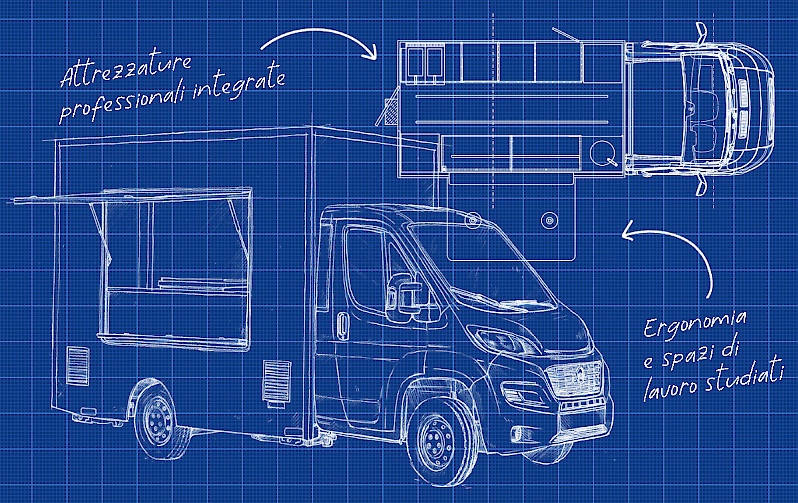
01. DRAWING DEFINES SPACES AND OPERATIONAL FUNCTIONALITY
Every centimetre of a food truck has its own function. The position of the work surface, the distance between equipment, the height of the service counter: nothing is left to chance. Technical drawing is the moment when these decisions are made — before they become physical structure and, therefore, irreversible.
Working well on paper means not having to make corrections in the workshop. And it means delivering a vehicle that truly works, from day one.
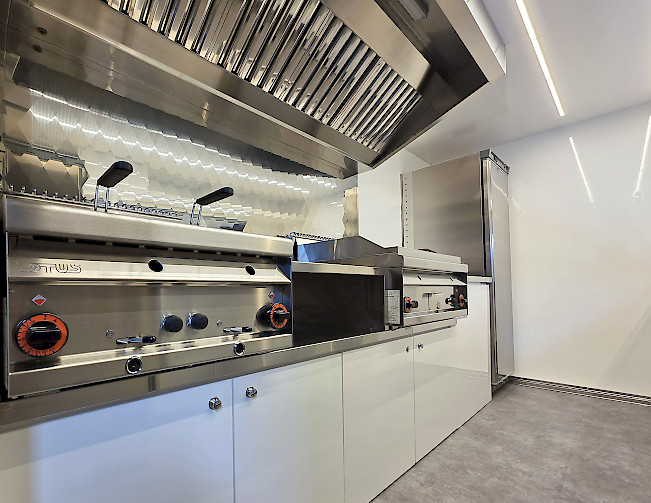
02. DRAWING TRANSLATES AN IDEA INTO A BUSINESS MODEL
Those who come to us often bring an intuition: a food concept, a format, an idea of how they want to work. Drawing is the step in which that intuition stops being abstract and becomes a concrete project — with measurements, layouts, operational flows.
It is not just representation: it is the design of how an activity will function every day. The vehicle becomes the working tool and, at the same time, the first visible expression of the business.
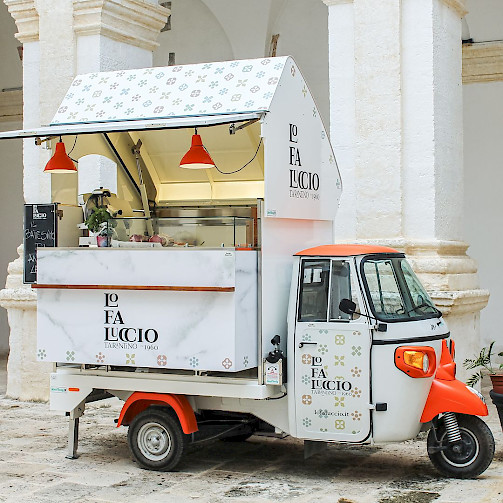
03. DRAWING BUILDS RECOGNISABILITY
Shapes, colours, proportions, materials: every aesthetic choice contributes to building an identity. A food truck is not just a vehicle on the road — it is a point of sale, an interface with the public, an extension of the brand of those who use it.
The aesthetic design phase is where the visual language takes shape: clean lines or a stronger character, a colour palette coordinated with the client's identity, details that make the vehicle immediately recognisable among many. It is work that requires listening and precision, just as much as the technical side.
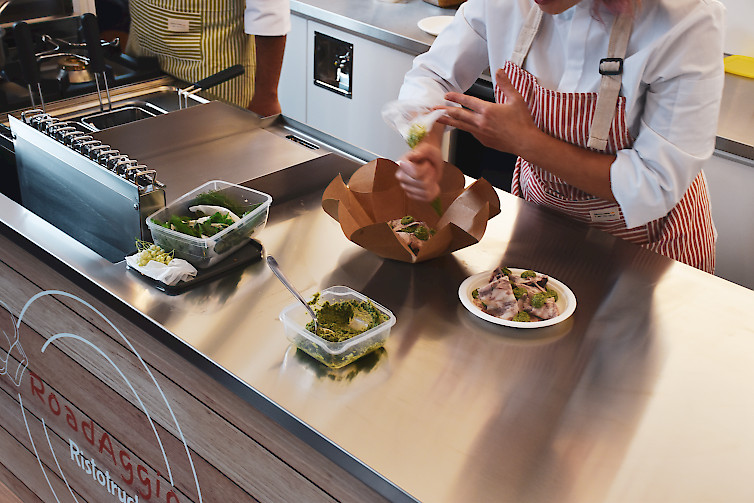
04. DRAWING SETS THE RHYTHM OF YOUR DAILY WORK
Ergonomics is not a detail. Those who work inside a food truck spend hours in a confined space, with repetitive movements, under the pressure of service. A well-designed layout reduces fatigue, increases execution speed, and improves the quality of work.
Thinking about how one works — before building — is perhaps the most concrete contribution that drawing can make. You don't see it in the final result, but you feel it every time the service runs smoothly.
For us, drawing is never a formal step. It is where the project takes shape, where important decisions are made, where an idea truly begins to become real. Before the first bolt is tightened.
